




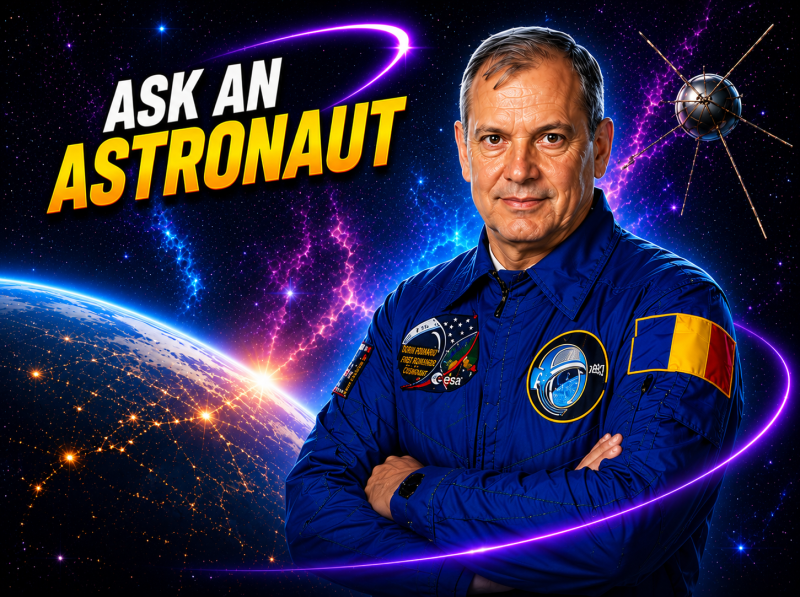
Romanian cosmonaut Dorin Prunariu, who led the push for the UN’s official Asteroid Day, discusses planetary defence and Luxembourg’s role ahead of the Asteroid Day Festival, by the Asteroid Foundation.
This article was written in collaboration with the Asteroid Foundation team.
International planetary defence: what works well today, and what still needs progress?
DP: Having chaired the United Nations Committee on the Peaceful Uses of Outer Space, and having been involved in bringing Asteroid Day to the United Nations, I have seen planetary defence evolve from a specialist scientific concern into a recognised global responsibility.
What works well today is the scientific and technical cooperation. We have better detection capabilities, more systematic observation of near-Earth objects, and a stronger international framework through bodies such as the International Asteroid Warning Network and the Space Mission Planning Advisory Group, both linked to the UN COPUOS process. Asteroid Day itself, proclaimed by the United Nations in 2016, has helped raise public awareness that asteroid impacts are not science fiction, but a low-probability, high-consequence natural hazard.
The greatest need for progress is political readiness. We know much more than before, but knowledge must be translated into decision-making procedures, funding, public-communication protocols, and international agreements on who does what in a crisis. Planetary defence cannot depend only on the goodwill of scientists — it must become part of national and international civil-protection planning.
“Planetary defence is one of the rare subjects where national interest and planetary interest are identical.”
Dorin Prunariu
What role can Luxembourg play in planetary defence?
DP: Luxembourg can play a very important role, precisely because it is a small country with an international outlook, strong financial expertise, and a clear strategic interest in space. In planetary defence, not every country needs to build a deflection spacecraft — but every country can contribute to preparedness.
Luxembourg can help in three ways. First, it can support European and international programmes through ESA and through diplomatic engagement in multilateral forums. Second, it can use its financial and legal expertise to encourage innovative funding mechanisms for planetary defence, including public-private partnerships. Third, through the Asteroid Foundation and Asteroid Day, Luxembourg can continue to be a global platform for awareness, education and dialogue between scientists, policymakers, business leaders and the public.
Planetary defence is one of the rare subjects where national interest and planetary interest are identical. Luxembourg understands this international logic very well.
After DART and Hera, what needs to happen next to move from demonstration missions to real operational readiness?
DP: NASA’s DART mission was a historic achievement. It proved, for the first time, that humankind can deliberately change the motion of a celestial body — NASA confirmed that DART altered Dimorphos’ orbital period around Didymos by about 32 minutes, demonstrating the effectiveness of kinetic-impact deflection.
ESA’s Hera mission is the necessary next step. It will examine the Didymos–Dimorphos system in detail and help turn the DART experiment into a better-understood and repeatable planetary defence technique.
Governments should now do four things: invest in early detection, since warning time is the most important factor; support mission planning for a range of asteroid scenarios, not just one demonstration case; organise regular international decision-making exercises involving legal, diplomatic, military, scientific and civil-protection authorities; and ensure planetary defence is treated as a permanent capability, not an occasional scientific project.
Technology has opened the door. Governments must now build the operational system behind it.
“From space, borders are invisible. The vulnerability of Earth is visible. That perspective should guide responsible leadership.”
Dorin Prunariu
What message would you give business leaders and policymakers about planetary defence?
DP: My message is simple: planetary defence is not an abstract cosmic issue. It is risk management at the scale of civilisation.
Business leaders understand risk. Policymakers understand responsibility. An asteroid impact may be rare, but if one occurs, the consequences can be regional, continental or even global. Unlike earthquakes or volcanoes, however, this is one natural disaster we may actually be able to prevent — if we prepare early enough.
Investment in planetary defence also strengthens technologies that benefit society more broadly: telescopes, data systems, artificial intelligence, space missions, communications, emergency planning and international coordination. Supporting planetary defence isn’t only about avoiding catastrophe — it’s about building a safer, more scientifically capable, and more cooperative world.
From space, borders are invisible. The vulnerability of Earth is visible. That perspective should guide responsible leadership.
More than four decades on, what is your most vivid memory from your 1981 Soyuz-40 spaceflight?
DP: The most vivid memory remains the first view of Earth from orbit. I had trained for years — I knew the equations, the procedures, the systems, the discipline of flight. But no training can fully prepare you for the emotional impact of seeing our planet suspended in the blackness of space.
The Earth was luminous, beautiful and fragile. The atmosphere, which protects all life, appeared as a very thin blue line. From that altitude, you don’t see political borders — you see one planet, one human destiny, and one shared responsibility. That image has never left me. It shaped not only how I understood spaceflight, but also how I later approached international cooperation, UN COPUOS, planetary defence, and the idea that space activities must serve all of humanity.
Read more
Ask An Astronaut | Julie Payette On Space
Ask An Astronaut | Mike Foreman On Spacewalks
Asteroid Day Festival Returns To Luxembourg