
How a Luxembourg-born, language-free learning platform scaled to fifteen countries across four continents, one evidence-backed partnership at a time.
Six years ago, Magrid Learning Solution started life as a small, Luxembourg-based project built on a simple but ambitious idea: that a child’s potential should never be limited by the language they speak, the school they attend, or the circumstances they were born into. Today, the company’s language-free learning and assessment tools have reached more than 60,000 children, in partnership with over 5,000 schools and teachers, across 15 countries on four continents.
For founder and CEO Dr. Tahereh Pazouki, the journey from Luxembourg startup to international EdTech company was never about a single breakthrough moment. “The internationalization of Magrid was not the result of one single event, but of a combination of scientific credibility and international recognition,” she says.
That credibility was built early. Magrid’s results have been published in peer-reviewed scientific journals, giving the company visibility beyond Luxembourg’s small domestic market from the outset. The real acceleration, however, came through international competitions. Selection for platforms such as the European Investment Bank’s Social Innovation Tournament and MIT Solve “gave Magrid exposure to a much broader ecosystem of investors, institutions, experts, and potential partners,” Pazouki explains — exposure that translated into a steady flow of inbound requests from outside Luxembourg, and the realization that the problem Magrid was solving was not a local one.
Looking back at those early years, Pazouki is candid about what the team underestimated. “We initially thought that the evidence behind the solution was mainly important for validating that it worked,” she says. “We did not fully anticipate how powerful that scientific credibility would become — not only for our international expansion, but also when engaging with investors, clients, and strategic partners.” That lesson pushed Magrid to make research and evidence generation a permanent pillar of its growth strategy, particularly valuable in new markets where the company had no existing reputation.
“[…] ultimately, what stays with you is the impact.”
Dr. Tahereh Pazouki, Founder and CEO of Magrid
Growing internationally at pace meant Magrid could not go it alone, and the company leaned heavily on local partners — from NGOs like Amis des Écoles to government bodies and investors such as Quadrian. But size, Pazouki notes, was rarely the deciding factor. “The biggest or most established player in a market is not necessarily the best partner for us,” she says. “What proved much more valuable were partners who believed in the solution, understood its potential, and were genuinely committed to building something together.”
Quadrian’s investment, meanwhile, brought more than capital. “The investment gave us the resources to accelerate our growth,” Pazouki says, “but equally important was the validation that came with having an investor who believed in Magrid, our mission, and the potential of the solution.” She is quick to credit the wider circle of investors and advisors who have supported the company along the way. “One of the things we have been particularly lucky with is the quality of the people who chose to believe in Magrid,” she adds.
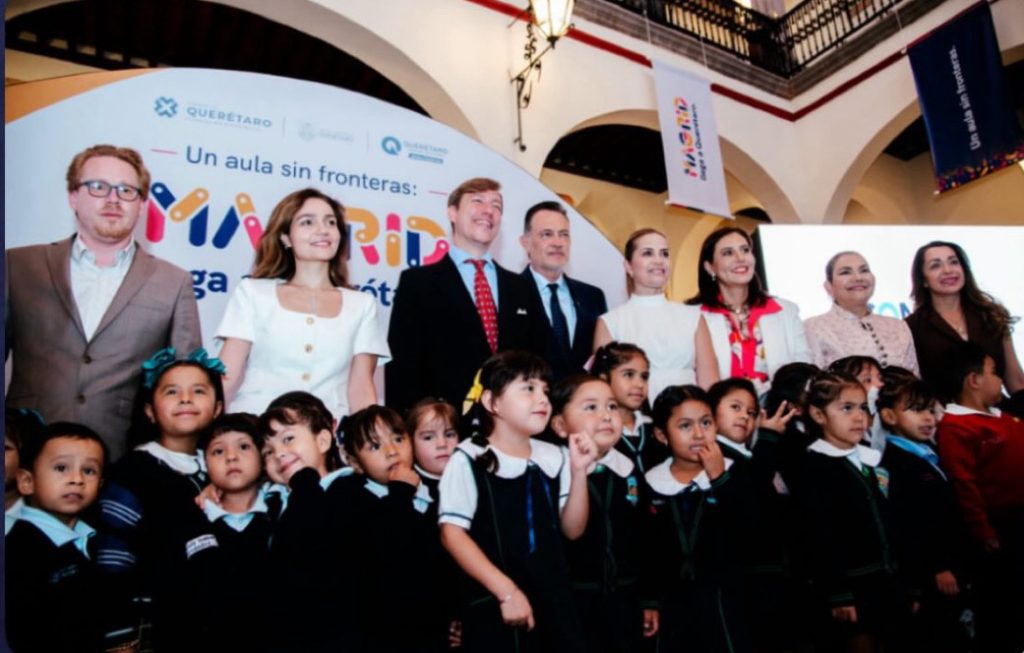
That combination of capital, credibility and local partnership has played out across Magrid’s expansion in Latin America. Before reaching more than 1,000 children in Querétaro, Mexico, the company had already built a presence in Colombia, Peru, Ecuador, Brazil and Panama, reaching 5,500 children in Peru alone. Mexico represented a market of a different scale, and Querétaro became the foothold for further expansion across the country. The key ingredient, Pazouki says, was again a strong local partner — one who “helped us establish direct conversations with government stakeholders,” significantly speeding up a process that would otherwise have taken far longer.
Magrid’s first deployment in Africa, in Morocco’s Atlas Mountains, tested the company’s model in a very different environment. Perhaps surprisingly, language was not the main obstacle. “One of the strengths of our solution is that it is language-free, which makes it much easier to implement across different countries and contexts,” Pazouki explains, calling the Morocco rollout a further validation of Magrid’s founding vision. The real challenges were operational: entering an unfamiliar market required patience, local understanding and, once again, the right relationships. “What stays with you is the impact,” she reflects. “When you actually see the children using the solution and you see the results they achieve, all the challenges that came before it suddenly feel much less important.”
“We need to plant multiple seeds and develop several markets in parallel.”
Dr. Tahereh Pazouki, Founder and CEO of Magrid
So how does Magrid decide where to go next? The approach, Pazouki says, is organic but strategic. Because it can take around two years to properly establish a new market, the company cannot wait for one to mature before starting the next — it has to “plant multiple seeds” in parallel. Organic website traffic from a given country is often an early signal of latent demand, and once Magrid has a foothold somewhere, expanding into neighbouring markets becomes easier, drawing on local knowledge and evidence already gathered.
Despite this global footprint, Luxembourg remains central to the story. “Luxembourg continues to play a very important role in our international expansion,” Pazouki says. Access to investors, universities, research networks and a multicultural environment helped Magrid build the credibility and partnerships it needed from day one — and the small size of the domestic market pushed the company to think internationally from the start. “Today, Luxembourg is still where we build, innovate, develop our evidence base, and coordinate our international growth,” she says, “while our local partners help us adapt and scale Magrid in individual markets around the world.”
Beyond Magrid’s own growth, Pazouki has strong views on the broader questions shaping early childhood education today — starting with screens. “One of the biggest misconceptions is that all screen time is the same,” she says. What matters, in her view, is not whether children use screens, but what they do on them and whether the technology “is supporting or replacing meaningful learning, interaction, and development.” For children with specific learning needs, she argues, technology can be less a luxury than a necessity — and parents’ own digital habits matter just as much as their children’s.
On artificial intelligence in the classroom, Pazouki sees genuine promise alongside real risk. AI’s ability to personalize learning, adapt to a child’s pace and give teachers better insight into individual needs is, she says, enormous. But she warns against using AI simply to hand children answers. “Learning requires effort, curiosity, problem-solving, making mistakes, and thinking independently,” she says. “If technology removes all of that cognitive effort, it can create the illusion of learning without necessarily creating real learning.” Adults, she adds, are role models — children learn how to use AI by watching how grown-ups around them use it.
“I believe technology should serve the child — not the other way around.”
Dr. Tahereh Pazouki, Founder and CEO of Magrid
That same philosophy underpins Magrid’s language-free design. By stripping away language as a variable, the platform aims to measure underlying cognitive processes — how children think, recognize patterns and solve problems — rather than what they already know. “The underlying cognitive processes that support learning are much more universal,” Pazouki says, arguing that two children with very different language exposure can share similar learning profiles, and vice versa.
Looking five years ahead, Pazouki frames Magrid’s ambitions in terms of responsibility as much as reach. “High-quality, inclusive education should not be a luxury — it should be a human right,” she says. “A child’s potential should not be limited by where they were born, how remote their community is, whether they have easy access to a school or educational resources, what language they speak, the colour of their skin, or whether they have a different learning profile or specific educational needs.” The next phase for Magrid, she says, is about expanding responsibly: entering new markets, generating stronger evidence, building the right partnerships, and reaching children who might otherwise be left behind.
Six years on, that mission still reads as a work in progress rather than a finished chapter. With a team of just twelve people coordinating an operation spanning four continents, Magrid’s story so far is as much about the partners, investors and educators who bought into that vision as it is about the technology itself. As Pazouki puts it, the next stage is not simply about adding more countries to the map, but about making sure every child Magrid reaches actually benefits from what the platform, and the evidence behind it, can offer.
Magrid in numbers
Children reached to date: 60,000+
Schools and teachers using Magrid: 5,000+
Countries active in: 15
Activities and lessons in the app: 4,200
Team size: 12
Founded: 2020
Growth: 206% retention; over €1.5M raised in equity and more than €1M in grants and awards